

What Defines Japanese Nordic Cuisine?
- cgiinternationalin
- May 11
- 5 min read
A scallop can arrive almost bare and still feel complete. A slice of fish, lightly cured, may carry more tension and clarity than a dish built from ten components. That is the quiet appeal of Japanese Nordic cuisine - a style of cooking where restraint is not minimalism for its own sake, but a way of protecting flavor, texture, and season.
For diners in Oslo, this expression feels particularly relevant. Nordic ingredients already carry a natural directness: cold-water seafood, herbs with short and intense seasons, berries, roots, seaweed, and clean dairy. Japanese culinary thinking offers a framework for treating those ingredients with precision. The result is not a novelty format or a passing fusion label. At its best, it is a coherent culinary language built on attention, balance, and respect.
Japanese Nordic cuisine is more than fusion
The term can easily be misunderstood. Fusion often suggests combination for effect - two culinary traditions placed side by side, or layered together in ways that are immediately visible. Japanese Nordic cuisine, when done seriously, tends to work differently. It is usually less interested in contrast than in alignment.
Japanese technique brings discipline in cutting, curing, grilling, stock-making, rice preparation, fermentation, and sequencing. Nordic cuisine contributes product identity, climate, terroir, and a long relationship with preservation through salting, pickling, smoking, and drying. These are not opposing systems. They meet naturally around seasonality, seafood, and a preference for purity over excess.
That is why the strongest examples rarely feel crowded. There may be very few elements on the plate, but each has a clear role. Fat is calibrated. Acidity is measured. Temperature matters. Texture is deliberate. Even garnish is treated as part of the architecture rather than decoration.
Why the combination works so well
There is a shared sensibility between Japan and the Nordics that goes beyond ingredients. Both traditions value the character of the raw material. Both understand that preservation is not only practical, but deeply culinary. Both have built serious food cultures around fish, shellfish, seaweed, broth, and subtle forms of seasoning.
In Japanese cooking, the idea is often to reveal the ingredient rather than overpower it. In Nordic cooking, especially in its modern fine dining form, the same instinct appears through season-driven menus and close attention to sourcing. When these philosophies meet, the conversation becomes unusually clear. A langoustine does not need theatrical handling. It needs exact timing. A piece of halibut may benefit more from a precise broth, a restrained glaze, or the right temperature than from elaborate construction.
This is also why seafood sits so comfortably at the center of the style. The cold waters of Norway provide ingredients with natural sweetness, minerality, and texture. Japanese methods offer elegant ways to deepen or frame those qualities, whether through delicate curing, binchotan grilling, kombu treatment, or the balance of soy, vinegar, and dashi-informed seasoning.
The role of seasonality in Japanese Nordic cuisine
Seasonality is often described too broadly, as if it simply means changing the menu four times a year. In refined cooking, seasonality is more exact than that. It means understanding when an ingredient is at its best, but also how it behaves at that moment - how much water it carries, how sweet it is, how firm it feels, how it responds to aging, grilling, curing, or serving raw.
Japanese Nordic cuisine depends on this sensitivity. Spring might call for a lighter hand, with green notes, clean broths, tender vegetables, and fish served with very little interruption. Autumn may allow for deeper umami, more developed ferments, richer shellfish preparations, and warmer textures. Winter can sharpen the focus on preservation, smoke, cure, and concentration.
Because of this, the style is especially suited to tasting menus. A set format allows the kitchen to compose a sequence around what is exceptional now, rather than building around fixed expectations. It also lets the meal move with intention - from snacks to sashimi, from nigiri to composed savory courses, then onward into a more relaxed final chapter with drinks and conversation.
Technique, not decoration
One of the clearest signs of serious Japanese Nordic cuisine is that much of the work is not announced. Guests may notice a polished surface and elegant service, but the craft often sits underneath the obvious. Fish may have been aged with extreme care to improve texture and deepen flavor. A broth may be built for transparency rather than intensity, requiring more judgment, not less. Rice for nigiri may be calibrated to room temperature, grain structure, and seasoning so precisely that the fish above it can remain almost unadorned.
This understated technicality is part of the appeal. Luxury in this context is not excess. It is control. It is the confidence to serve premium ingredients in ways that preserve their identity instead of masking them.
That principle also creates discipline around richness. Caviar, shellfish, fatty fish, or butter-based elements can all appear in the style, but they must be integrated with balance. If every course pushes for impact, the meal loses shape. The strongest kitchens understand pacing. They know when to sharpen the appetite, when to provide depth, and when to leave silence on the plate.
Japanese Nordic cuisine in a restaurant setting
For guests, this cuisine is best understood as an experience rather than a category. It asks for trust. The chef chooses the progression. The dining room supports the rhythm. Pairings, whether wine or something more unexpected, become part of the same structure.
That matters because this style is at its strongest when service and kitchen operate with the same sensibility. Precision on the plate needs composure in the room. Timing, explanation, and atmosphere all shape how the food is perceived. A calm, informed front-of-house team can make a restrained dish feel expansive by placing it in context without over-explaining it.
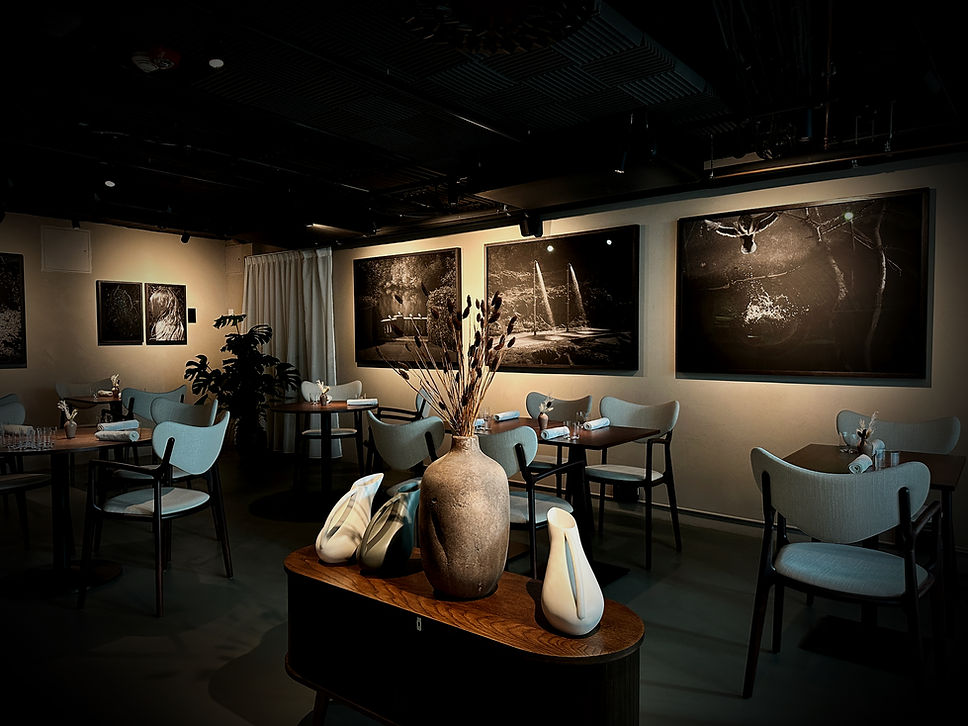
In Oslo, this has created space for restaurants that function as full-evening destinations rather than simple dinner reservations. The meal begins with concentration and detail, then relaxes into a longer, more atmospheric close. At Substans, that progression reflects the cuisine itself - measured, seafood-led, seasonal, and quietly exacting.
What diners should expect
Anyone approaching Japanese Nordic cuisine should leave behind the idea of abundance as quantity. The value is in precision, rarity, and cohesion. A tasting menu may include many servings, but the purpose is not volume. It is to create momentum and contrast with care.
Guests can expect raw and lightly treated seafood to play a central role. They can also expect subtle shifts rather than dramatic swings - a move from salinity to sweetness, from warm broth to cool sashimi, from the compact focus of nigiri to a composed main course with more structure. The best meals feel cumulative. By the later courses, earlier details begin to echo in more developed forms.
There is, however, a trade-off. This style is not for diners seeking broad choice or immediate familiarity. Because the menu is curated, the pleasure comes from surrendering some control. That is part of the luxury, but it does depend on mindset. Guests who enjoy chef-led dining, omakase-adjacent formats, and ingredient-driven cooking tend to understand the value instinctively.
Why it continues to matter
Japanese Nordic cuisine remains compelling because it has substance behind the aesthetic. It is not simply clean plating and premium fish. It is a way of thinking that asks difficult questions: what does this ingredient need, what should be removed, what can be improved through time, temperature, and sequence, and when is less actually more?
For a discerning diner, those questions matter. They separate trend from craft. They also explain why this style has found such a natural home in a city like Oslo, where access to extraordinary seafood and a mature dining audience can support serious, season-led cooking.
The real pleasure of Japanese Nordic cuisine lies in its restraint. It rewards attention. It asks you to taste carefully, not quickly. And when it is handled with confidence, the meal does not need to insist on its significance. You simply feel, course by course, that very little has been left to chance.


Comments