

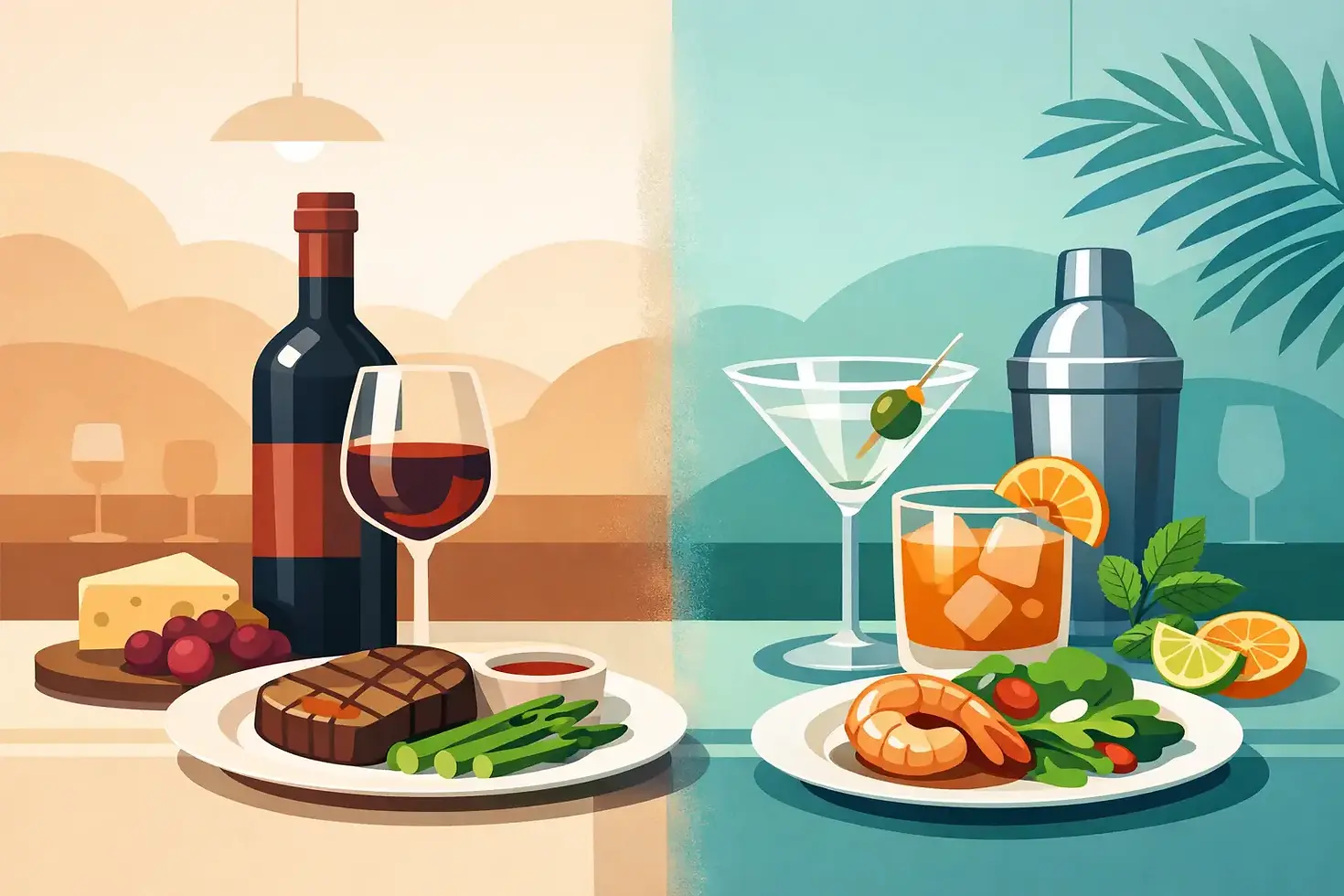
Wine Pairing vs Cocktail Pairing at Dinner
A well-chosen drink does more than accompany a course. It adjusts its shape: sharpening the mineral clarity of sashimi, rounding the salinity of caviar, or carrying the warmth of a grilled main into its finish. In the discussion of wine pairing vs cocktail pairing, the question is not which is more sophisticated. It is which medium best serves the menu, the season and the pace of the evening.
For a seafood-led tasting menu with Japanese and Nordic sensibilities, both can be exceptionally precise. Wine offers continuity, transparency and a long vocabulary of regional expression. Cocktails offer a more immediate form of composition, with temperature, dilution, aroma and texture calibrated for a single moment. Their strengths are different, and the most satisfying choice often depends on how you prefer to experience a meal.
Wine pairing vs cocktail pairing: two ways of framing flavour
Wine pairing works through resonance and contrast, but it also creates a thread between courses. A lean white with measured acidity can echo the clean sweetness of scallop. A textured, lees-aged wine can meet richer fish or a sauce built on butter, miso or roasted bones without taking over. With each glass, the guest encounters a place, a vintage and a particular interpretation of fruit, soil and cellar work.
Cocktail pairing is more architectural. A drink can be built around a single course with remarkable specificity: a saline note for raw fish, clarified fruit for delicate shellfish, or a whisper of smoke beside a charred element. The bartender controls sweetness, acid, alcohol level, carbonation and serving temperature with a degree of precision that wine cannot always provide.
This does not make cocktails inherently more expressive. Their effect is simply more deliberate and immediate. Where wine may reveal new details as it warms in the glass, a cocktail arrives at a defined point of balance. That distinction changes the rhythm of the table.
What wine brings to a tasting menu
Wine is especially compelling when the menu develops gradually from raw, cool and saline courses toward deeper, warmer preparations. It has the patience to move with that progression. A thoughtful pairing can begin with a bright, restrained sparkling wine, move toward finely textured whites, and finish with a lighter red or oxidative style when the cooking gains intensity.
Acidity, texture and restraint
Acidity is often wine's most useful quality at the table. It refreshes the palate after richness, heightens the clean flavour of seafood and keeps a sequence of small courses from feeling heavy. Yet acidity alone is not enough. A wine must also have the right texture. Very lean wines can make a buttery sauce seem broader and more prominent; a wine with some lees-derived softness may bring the elements back into proportion.
Japanese Nordic cooking frequently asks for this kind of restraint. The ingredient may be pristine langoustine, halibut, king crab or a carefully prepared vegetable, supported rather than concealed by umami, fermentation, broth or a subtle infusion. Wines that are excessively aromatic, heavily oaked or high in alcohol can flatten those distinctions. The best match has enough character to hold its place, but leaves space for the food to speak.
The value of evolution
Wine also rewards attention across time. A glass can open over several courses, changing slightly as it meets food and room temperature. That evolution suits diners who enjoy following a narrative through the meal rather than encountering a series of isolated impressions.
There is a practical advantage as well. Wine generally sits comfortably beside food for longer. Guests can return to a glass after a conversation, revisit it with a later bite and notice a different relationship. In a calm, extended dinner, this continuity can feel particularly natural.
Wine is not always the easiest answer, however. High-umami preparations can make some wines taste harder, more bitter or less generous. Vinegar-led acidity, chilli, pronounced sweetness and certain fermented elements can also be challenging. A skilled sommelier can navigate these tensions, but occasionally a cocktail has the cleaner solution.
What cocktail pairing can do differently
A cocktail pairing begins with the dish rather than with a bottle. It can take a scent from the kitchen and translate it into the glass: spruce, shiso, sea buckthorn, dill, roasted rice, pear, citrus peel or a discreet marine salinity. Done well, this is not garnish-led theatre. It is a way to make aroma part of the course.
Precision at the point of service
A cocktail can be served ice-cold, gently carbonated, clarified to silkiness or warmed into a light, fragrant serve. It may be dry enough to frame a raw course, or lightly rounded to soften a sharper fermented note. For a bite of nigiri, a small highball with sake, aquavit and citrus can offer lift without competing with the rice. For a richer fish course, a stirred, umami-aware drink may supply depth while retaining a clean finish.
The scale matters. In a tasting menu, cocktail servings should be composed with discipline. Full-size drinks can fatigue the palate and obscure the detail of later courses. Smaller pours, moderated alcohol and clear transitions allow the pairing to remain part of the meal rather than becoming its dominant feature.
Cocktails can also meet difficult ingredients with uncommon accuracy. A touch of sweetness can settle heat. Carbonation can brighten a fatty or fried element. A saline solution can reinforce the natural taste of shellfish without introducing the tannin or sharpness that a particular wine might bring. For guests who favour vivid aromatic expression, this can be highly persuasive.
Where cocktails require care
The same flexibility creates risk. A cocktail with too many flavours becomes another dish on the table, and a heavily sweetened or aggressively perfumed drink can quickly overwhelm fine produce. Repetition is another concern. If every serve arrives with smoke, foam, intense botanicals or a dramatic garnish, the experience loses its sense of proportion.
Cocktail pairings also ask guests to accept a faster cadence. Most are designed to be enjoyed at their intended temperature and dilution. This can create a focused, lively service, but it may feel less relaxed for someone who likes lingering over one glass while the table settles into the course.
Choosing based on the menu and the occasion
The choice becomes clearer when it is considered alongside the cooking. A menu centred on raw fish, shellfish, precise broths and subtle variations in texture often benefits from wine's linearity and calm. Mineral whites, sake-adjacent styles, elegant sparkling wines and restrained aromatic varieties can extend those qualities without interrupting them.
A menu with more pronounced smoke, fermentation, spice, grilled elements or fruit-driven acidity may invite cocktails into the conversation. This is especially true when the kitchen uses Nordic herbs, distillates and preserved seasonal ingredients. A cocktail can reflect those details directly while preserving the freshness required by seafood.
Occasion matters as much as flavour. Wine pairing is often the natural choice for a celebratory dinner where the pleasure lies in settling into the evening, comparing glasses and allowing a progression to unfold. Cocktail pairing suits guests looking for a more contemporary, sensory experience, with each course marked by a distinct aromatic gesture.
There is also no obligation to treat the decision as absolute. Some of the most balanced evenings move between the two. Sparkling wine may set an elegant opening, a carefully built cocktail may accompany a complex central course, and a final glass in the lounge can extend the experience beyond the last plate. At Substans, the drinks experience can be considered as part of the full arc of the evening, not a separate decision made after dinner begins.
The role of the service team
A pairing becomes memorable through timing as much as selection. The drink should arrive at the right temperature, in the right measure, with enough context to guide the guest but not so much explanation that the table becomes a classroom. Fine service reads the pace of the room. It knows when a glass needs a few minutes to open and when a cold cocktail should be placed down moments before the dish.
Guests should feel comfortable sharing preferences before the menu begins. A preference for lower alcohol, dry drinks, classic wine regions, sake, herbal flavours or minimal sweetness gives the team useful direction. Dietary considerations and sensitivities matter too, particularly where a cocktail may contain ingredients that are less obvious than those in a wine.
The best recommendation is not the most unusual bottle or the most technically intricate cocktail. It is the one that makes the next bite more complete. Choose the pairing that matches how you want to remember the evening: as a gradual conversation between food and wine, or as a succession of precisely composed moments in the glass.


Comments